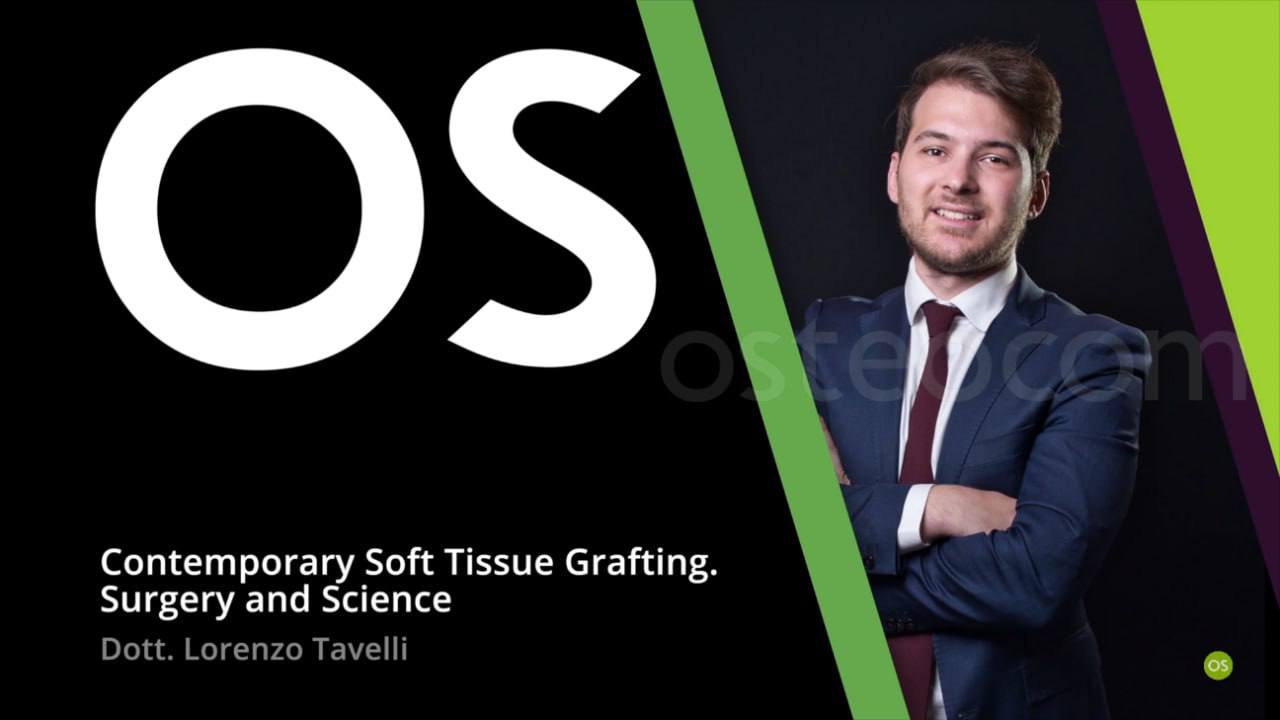
Contemporary Soft Tissue Grafting, Surgery and Science
Contemporary Soft Tissue Grafting, Surgery and Science
Category: Surgery
Instructor(s): Lorenzo Tavelli
Course structure: Lessons: 11 lessons | Duration: 10 h 22 min
Course overview
The complete online course on cutting-edge protocols and minimally invasive techniques in soft tissue grafting.
With the development of new surgical techniques and the introduction of breakthrough biomaterials some concepts on periodontal surgery that were strictly applied in the past seem to be not so critical today.
Recent advances in tissue engineering, and biomaterials, such as acellular dermal matrices and xenogeneic collagen matrices, allow the oral care specialist to offer less invasive alternatives to her/his more traditional treatment strategies.
Root coverage, soft tissue phenotype modification at tooth and implant sites, peri-implant maintenance protocols, corrections of implant esthetic complications and periodontal plastic surgery have all been touched by the current treatment trends, aimed at offering contemporary, less invasive and predictable treatment options to a wider audience of patients.
Who this course is for:
Specialists in periodontics and implant dentistry, as well as general practitioners, will benefit from this course, improving their knowledge and effectively adding cuttingedge knowledge to their surgical skill set in soft tissue grafting
What you are going to learn:
- Indications, guidelines and protocols for minimally invasive soft tissue grafting around natural teeth and implants.
- How to effectively perform minimally invasive advanced soft tissue augmentation procedures with novel matrices and growth factors.
- Predictable prevention and successful management of peri-implant complications in the esthetic zone.
- The rationale behind the next generation of tissue engineering and the sinergy with soft tissue grafting protocols.
At the end of the course you will:
- Become proficient in periodontal and peri-implant soft tissue management.
- Understand when and how to use soft tissue substitutes VS autogenous soft tissue grafts.
- Improve your skill set with innovative soft tissue grafting procedures.
- Promote soft tissue surgery in your everyday practice by proposing less invasive treatment options to a wider audience of patients.
Curriculum
Physiological anatomy and mucogingival deformities of periodontal and periimplant tissues
- Lesson program:
- Anatomy of healthy periodontal and peri-implant tissues - Periodontal and peri-implant phenotype
- Techniques for assessing gingival/mucosal thickness and its significance
- Gingival recessions: etiological factors, classification, and rationale for treatment
The free gingival graft. Is it still used nowadays?
- Lesson program:
- Is keratinized tissue needed to promote/maintain periodontal health?
- Is free gingival graft indicated for root coverage procedures?
- Is keratinized tissue needed to promote/maintain peri-implant health?
- Rationale, indications, and surgical approaches for increasing keratinized tissue around teeth and implants
Gingival recessions. Coronally advanced flap or tunnel technique?
- Lesson program:
- Critical factors affecting the outcomes of coronally advanced flap and tunnel techniques
- Advantages and disadvantages of the two approaches - Evolution of the techniques and their expected clinical, esthetic and patientreported outcomes
- The tunneled coronally advanced flap
The connective tissue graft. Indications and harvesting considerations
- Lesson program:
- Contemporary understanding of connective tissue graft indications
- Site-specific application of connective tissue graft
- Palatal harvesting techniques: risk of complications, graft quality and palatal wound healing physiology
- Management of palatal harvesting complications and post-operative pain reduction
Acellular dermal matrix. When and how?
- Lesson program:
- Rationale for using acellular dermal matrices
- Structures and properties of dermal matrices
- Expected root coverage outcomes and phenotype modification
Xenogeneic collagen matrices. Properties, indications, and handling for optimizing clinical and volumetric outcomes
- Lesson program:
- Properties and indications of different generation of collagen matrices
- Collagen matrix in combination with apically positioned flap at teeth and implant sites
- Novel cross-link collagen matrix for root coverage procedures and peri-implant soft tissue augmentation
Growth factors and tissue engineering. The future is now.
- Lesson program:
- Evolution of techniques and biomaterials
- Tissue engineering triad
- Living cellular constructs
- Growth-factor mediated root coverage procedures
Peri-implant soft tissue dehiscences. Prevention and treatment.
- Lesson program:
- Risk indicators for peri-implant soft tissue dehiscence
- New classification of peri-implant soft tissue dehiscence
- Contemporary surgical approaches and strategies for assessing treatment outcomes
- Crown removal and new prosthesis: when is it necessary?
ReLIVE Surgery 1
- In 3 parts.
- Coronally advanced flap with a xenogeneic acellular dermal matrix for the treatment of two adjacent maxillary gingival recessions.
ReLIVE Surgery 2
- Tunneled coronally advanced flap (TCAF) in combination with a xenogeneic collagen matrix for root coverage and soft tissue phenotype modification in the upper right area.
ReLIVE Surgery 3
- In 2 parts.
- Tunneled coronally advanced flap (TCAF) with a xenogenic acellular dermal matrix for the treatment and soft tissue phenotype modification of multiple adjacent gingival recessions.
Couldn't load pickup availability