1
/
of
1
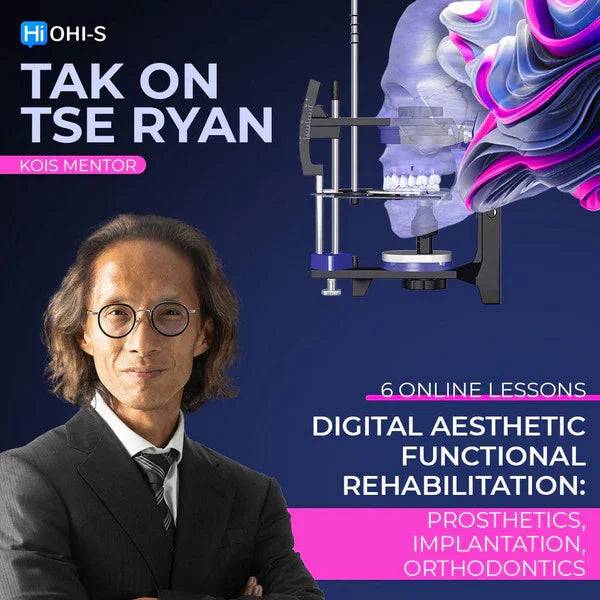
Digital Aesthetic Functional Rehabilitation: Prosthetics, Implantation, Orthodontics
Digital Aesthetic Functional Rehabilitation: Prosthetics, Implantation, Orthodontics
Regular price
$20.00 USD
Regular price
$290.00 USD
Sale price
$20.00 USD
Shipping calculated at checkout.
Digital Aesthetic Functional Rehabilitation: Prosthetics, Implantation, Orthodontics
Category: Surgery
Instructor(s): Tak On Tse Ryan
Course structure: Lessons: 6 lessons | Duration: 6 h 10 min
Course overview
Digital Aesthetic Functional Rehabilitation: Prosthetics, Implantation, Orthodontics
On the course you will learn how to work in the Kois principle:
– Create a perfect Digital Smile design considering:
- dental parameters
- facial driven features
- gingival parameters.
– Do aligner orthodontics according to Digital smile design treatment goal
– Create functional restorations on natural teeth and implants in a digital protocol.
Lecturer Tak On Tse Ryan is a Kois mentor.
Curriculum
Smile design. Principles and sequence according to the Kois principles
- Lesson program
- – What information is required for the Smile Design? Parameters to be considered for Smile Design
- – Lip dynamics and incisal edge position
- – Etiology, clinical feature, diagnosis, and treatment of gingival smile
- – Tooth proportion measurement tools
- – Closed lengthening of the tooth crown with a laser
- – Duchenne smile as a tool for the dynamics of the position of the upper lip and the canine exposure determination
- – 6 stages of smile planning according to John Kois and Frank Speer
- – The rule for assessing the position of the incisors "4\2\2" from Edward McLaren
- – Golden Ratio for face proportions estimation
- – Landmarks to create an approximal contact between the central incisors
- – Phonetic analysis
- – Integration of the midline with the occlusal plane and the interincisal midline on the model. Transferring data to the laboratory
- – Algorithm: how to calculate the crown height increase
- – Analysis of clinical cases.
- Recommended for: Prosthodontists, Orthodontists, General dentists.
Facial Analysis and Smile Design based on DSD and Kois Principle
- Lesson program
- – Dental parameters. Fundamental objective criteria
- – The position of the gingival zenith and the level of the maxillary frontal teeth
- – The rule "50:40:30"
- – Factors affecting the shape of the tooth
- – Registration and transfer of the midline position to plaster models. Protocol of working with the "Ditramax" device
- – Protocol for working with the John Kois dentofacial analyzer
- – Requirements for DSD photography
- – Sequential 6 steps of DSD protocol
- – Combined use of the Kois dentofacial analyzer and DSD
- – Working with the gingival margin level in DSD
- – Lengthening of the crown part of the teeth in digital protocol
- – VISTA technique and modified fibrin-associated recession closure technique
- – The midline of the face. The concept of smooth facial contours
- – Determining the shape of the anterior teeth during DSD, taking into account the anthropometric parameters of the patient. Morphopsychology
- – Color and optical properties of the teeth
- – Lip volume. Assessment of objective parameters and their correction.
- Recommended for: Prosthodontists, Orthodontists, General dentists.
Occlusion Principle in Full mouth rehabilitation under Kois Principle
- Lesson program
- – Terminology:
- Maximal intercuspal position (MIP)
- Central relation (CR)
- Vertical dimension of occlusion (VDO).
- – Gnathologic principles
- – Condylar movements: Bennet movement, Bennet angle
- – Anterior guidance
- – Dynamic system: variability and adaptation
- – Physiologic occlusion
- – Acceptable functions: chewing, swallowing, speaking and breathing
- – Constricted chewing patterns
- – Occlusal dysfunction and parafunctions
- – Three P's according to the Kois principles: Position, Place, Paceway
- – Transferring the emergence profile of multiple implant restoration
- – Kois questionnaire
- – Risk assessment: occlusion stress test
- – Functional occlusion therapeutic considerations
- – Central relation technique:
- Bilateral manipulation
- Lucia jig
- Leaf gauge
- Kois deprogrammer
- Bite plane
- Occlusal splint.
- – Characteristics of Kois deprogrammer
- – Benefits of a Kois deprogrammer.
- Recommended for: Prosthodontists, Orthodontists, General dentists.
Digital orthodontics in functional esthetics
- Lesson program
- – Minimal invasive dentistry
- – Invisalign® principle
- – Central occlusion and functional overjet
- – Acceptable function and aberrant adaptive envelopes
- – Constricted chewing pattern
- – 3 features for functional diagnosis: Kois questionnaire, clinical examination, the mounted cast after Kois deprogrammer
- – Choosing a method for malocclusion treatment
- – DSD in orthodontic treatment planning. Clincheck usage
- – Correction of X-bite and tilted midline
- – Intrusion and retraction of lower incisors
- – Invisalign® tooth movement.
- Recommended for: Prosthodontists, Orthodontists, General dentists.
Total oral rehabilitation on natural teeth in a digital workflow
- Lesson program
- – 6 steps for total rehabilitation planning
- – 6 categories of functional occlusion
- – 3 features for functional diagnosis: Kois questionnaire, clinical examination, the mounted cast after Kois deprogrammer
- – The Kois questionnaire:
- personal history
- dental history.
- – Periodontal risk assessment
- – Biomechanical risk assessment
- – Bite and jaw joint
- – Occlusal VDO: treatment planning decisions and management considerations
- – Facial driven treatment plan
- – Influence of stabilization occlusal splint on craniocervical relationships
- – The rule of three P's: position, place, pathway
- – T-Scan software: digital evaluation of occlusion
- – Full mouth rehabilitation of severe Class III dentition: prosthetic driven orthodontic with raised VDO.
- Recommended for: Prosthodontists, Orthodontists, General dentists.
Total oral rehabilitation on implants in a digital workflow
- Lesson program
- – Guided implant surgery and DSD
- – Facial analysis for the digital planning of full mouth implant rehabilitation
- – Guidelines for maxillary incisal edge position
- – Gingival architecture
- – Mandibular incisal edge
- – Mandibular tooth display analysis
- – Speech problem management
- – Taking accurate implant impression
- – Transferring the CR and tooth position from the provisional to final
- – Biological and mechanical complications in full mouth implant rehabilitation
- – Avoiding complications
- – Cross mounting into articulator
- – Difference in biomechanic between tooth and implant
- – Implant and tooth supported fixed prosthetics using Pekkton framework
- – Using the digital-centric record technique to enable digitally planned implant treatment for an edentulous patient.
- Recommended for: Prosthodontists, Orthodontists, General dentists.
Quantity
Couldn't load pickup availability