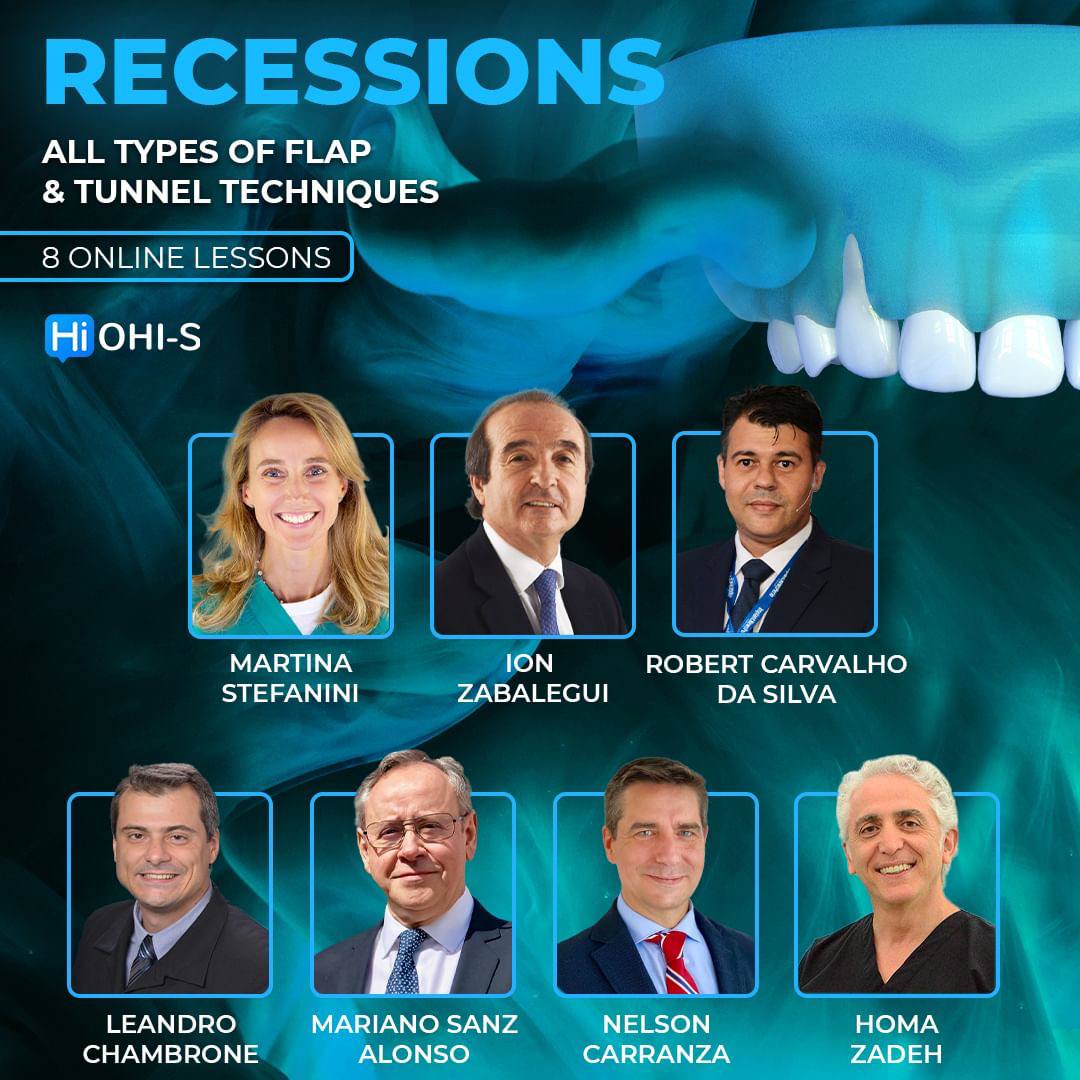
Recessions: All Types of Flap & Tunnel Techniques
Recessions: All Types of Flap & Tunnel Techniques
Root Coverage Techniques: Tunnel, Flaps, VISTA, Pinhole, LAST
Category: Surgery
Instructor(s): Homa Zadeh, Robert Carvalho da Silva, Martina Stefanini, Leandro Chambrone, Ion Zabalegui, Nelson Carranza
Course structure: Lessons: 7 lessons | Duration: 10 h 30 min
Course overview
Masterclass in Gingival Recession Treatment.
The most complete course in recession treatment is here!
Learn all the key methods to manage and treat gingival recession, guided by world-renowned experts in the field.
Topics Covered:
-Strategy for selecting techniques and materials for recession treatment
-Tunnel technique for single and multiple gingival recessions
-Treatment of deep (severe) recessions with LAST (Laterally Stretched Flaps)
-Pinhole surgical technique protocol
-VISTA technique protocol
-Soft tissue management during implant procedures
-Extraction socket management
Ideal For:
-Periodontists
-Implantologists
-General Dentists
-Dental Surgeons specializing in soft tissue management
What You Will Learn:
-Master various gingival recession treatment techniques
-Understand when and how to apply VISTA, Pinhole, Tunnel, and LAST techniques
-Improve treatment outcomes for both aesthetic and functional cases
Curriculum
1. Periodontal Plastic Surgery with VISTA – Part 1
- Lesson program:
- – Periodontal plastic surgery: indications and risk assesment;
- – Periodontal plastic surgery techniques:
- Coronally advanced flap,
- Laterally closed tunnel,
- Pinhole surgical technique,
- Vestibular incision subperiostal tunnel access (VISTA);
- – Root prominence classification;
- – Odontoplasty;
- – Recession outcome predictors:
- Flap tension,
- Gingival margin position,
- Flap thickness;
- – Full and partial thickness flap: comparison;
- – Material selection:
- Autograft,
- Allograft,
- Growth factors,
- – Tuberosity harvest;
- – VISTA:
- Advantages,
- Step by step protocols,
- Clinical cases,
- Long-term results.
2. Periodontal Plastic Surgery with VISTA – Part 2
- Lesson program:
- – Peri-implant plastic surgery: indications and risk assessment;
- – Gingiva vs peri-implant mucosa;
- – Significance of peri-implant mucosa;
- – Importance of implant position;
- – Soft tissue augmentation techniques:
- Free gingival graft (FGG),
- Allograft/xenograft,
- L-PRF,
- Pedicle flap,
- Vascullarized inter-position (VIP) graft,
- VISTA;
- – Material selection:
- Connective tissue graft (CTG),
- Tuberousity,
- Allograft/xenograft,
- Growth factors,
- – Extraction socket management;
- – Soft tissue management during implantation;
- – Flap design;
- – Vestibular depth management:
- Fibrin immobilisation vestibular extension (FIVE) technique;
- – Esthetic enhancement;
- – Clinical cases.
3. Predictability of Root Coverage Procedures: Clinical Scenarios & Evidence
- Lesson program:
- – The main factors influencing the predictability of root coverage procedures according to the different patient-, procedure- and outcome-related factors;
- – The main clinical scenarios depicted in the AAP Regeneration Workshop;
- – Evidence-based findings on soft tissue (RC) of recession-type defects to daily clinical practice;
- – Evidence-based findings to clinical practice, by presenting treatment approaches to the most common “clinical scenarios” related to gingival recession treatment;
- – The influence of the keratinized tissue band on the long-term stability of results achieved by reconstructive soft tissue procedures.
4. Tunnel Technique for Single and Multiple Recession
- Lesson program:
- – Mucogingival surgery: principles of biological healing
- – Phases of graft healing
- – Split and full-layer flap: advantages and disadvantages
- – RT сlassification of recessions
- – Bilaminar technique for eliminating single and multiple recessions
- – Indications and goals for surgical elimination of recession
- – Contraindications for conducting tunnel technique
- – Сollection of a connective tissue graft from the palate: the significance of the anatomy and phenotype of the donor site
- – Tunnel technique: protocol and demonstration of the methodology
- – New surgical approach for treating RT3 recession.
5. Root Coverage Decision Tree: Tunnel vs. Flap Procedures
- Lesson program:
- – Decision-making strategies for treating various forms of recession;
- – The decision tree;
- – Advantages and disadvantages of using tunneling procedures and regular flaps;
- – Comparative characteristics of the use of autologous tissue graft vs substitutes and growth factors;
- – The etiology of the gingival recessions;
- – When applying the connective tissue graft;
- – The role of the growth factors;
- – The proper indications of the tunneling procedure;
- – The technique step by step.
6. Treating Deep Recessions with LAST (Laterally Stretched Flaps)
- Lesson program:
- – Diagnosis and decision criteria for treatment of gingival recessions;
- – Treatment alternatives for deep/narrow and deep/wide recession defects;
- – The Laterally Stretched Flap concept: Technical variants;
- – Palatal connective tissue harvesting with the Modified Double Blade Harvesting Technique;
- – Selection of an adequate grafting technique, and graft customization to the recipient bed
- – Management of complex cases: Multiple deep recessions.
7. Coronally Advanced Flap: When is a Connective Tissue Graft Needed?
- Lesson program:
- – Coronally advanced flap: indications
- – Connective tissue graft sampling:
- Trap door
- "L" technique
- Envelope technique.
- – Selection of the donor zone for graft collection
- – Advantages of de-epithelized graft
- – Closing recessions: anatomical and clinical aspects of the choice of treatment method
- – Surgical protocol for the treatment of a single recession: a clinical example
- – Closing multiple recessions: a technique for creating a forced recession
- – Treatment of gingival recessions in the molar region: protocol.
Couldn't load pickup availability