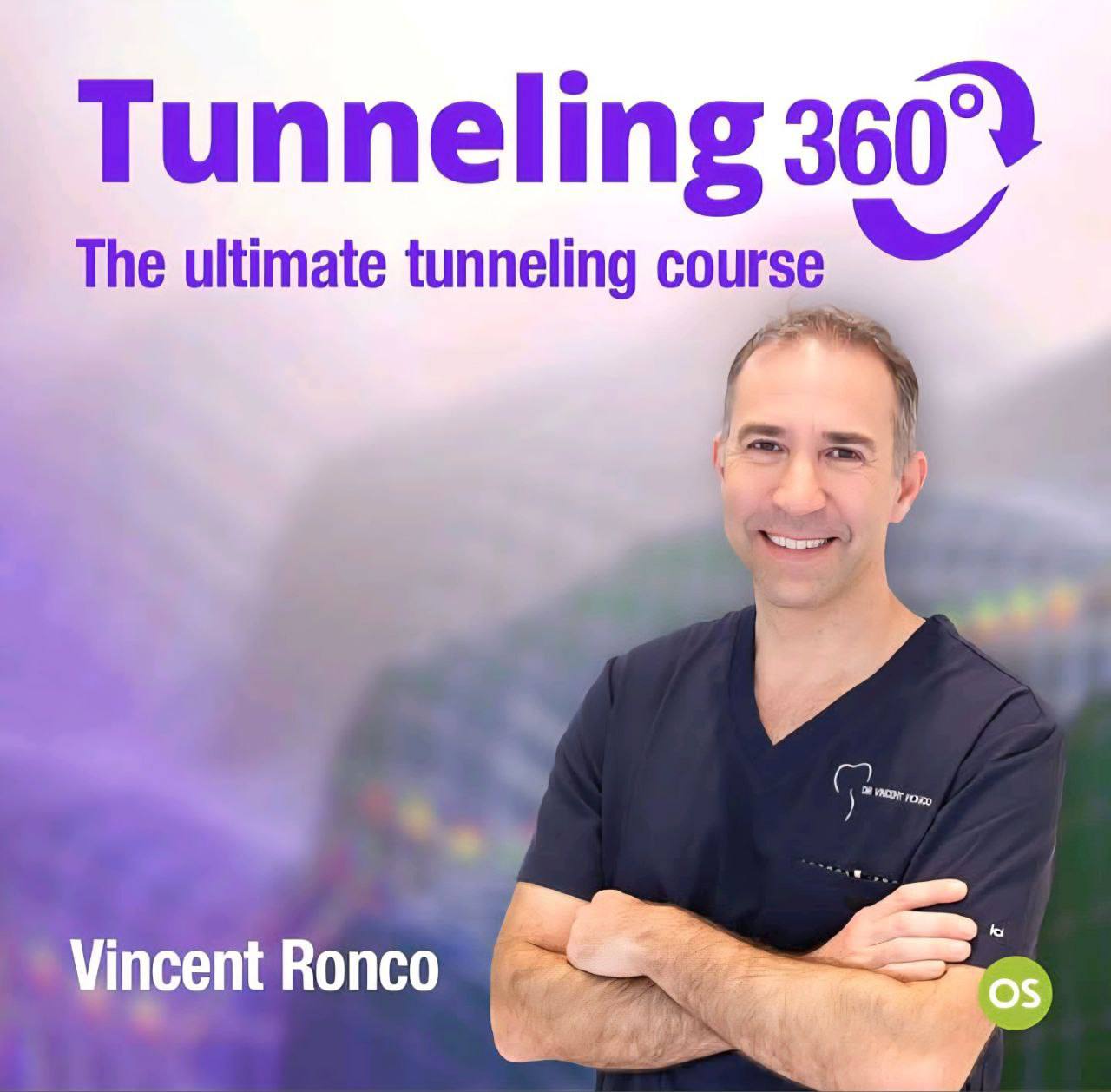
Soft Tissue Tunneling Excellence: Predictable Aesthetics with CTG
Soft Tissue Tunneling Excellence: Predictable Aesthetics with CTG
Category: Surgery
Instructor(s): Vincent Ronco
Course structure: Lessons: 15 lessons | Duration: 7 h 40 min
Course overview
This comprehensive video course entirely dedicated to minimally invasive tunneling techniques for the treatment of gingival recessions. This innovative, predictable approach ensures excellent aesthetic results and optimal graft integration with minimal trauma.
Dr. Vincent Ronco delves into advanced tunneling procedures in Implant Dentistry, comparing Traditional and Modified Tunnel Techniques in terms of surgical execution and soft tissue management. The course covers multiple connective tissue grafting protocols (fully covered, exposed, and partially covered), as well as precise techniques for harvesting and de-epithelializing grafts.
You’ll also learn advanced suturing methods, including Dr. Ronco’s signature Belt & Suspenders Technique, designed to optimize graft stabilization and healing control.
Topics Covered:
-Traditional vs. Modified Tunnel Techniques
-Clinical indications and tunneling protocols
-CTG harvesting from the palate and tuberosity
-Root surface conditioning strategies
-Types of grafts and their application
-Continuous grafts vs. micro-grafts
-Belt & Suspenders suturing technique
-Prevention and management of complications
By the End of the Course, You Will Be Able To:
-Choose and apply the appropriate tunneling technique for each clinical case
-Harvest connective tissue grafts using various methods
-Minimize invasiveness and patient discomfort at the donor site
-Secure and stabilize grafts with advanced suturing techniques
-Treat gingival recessions using minimally invasive surgical strategies
-Preserve soft tissues and optimize therapeutic outcomes
-Achieve highly predictable aesthetic and functional results
-Effectively manage intra- and post-operative complications
Curriculum
Lesson 1: Course introduction
- Dr. Vincent Ronco welcomes you to this learning experience focused on the tunneling technique and its various applications. In this introduction, he summarizes the key topics that will be treated during the course.
Lesson 2: Definition of periodontal recession
- Periodontal recession is defined as the apical migration of the gingival margin beyond the CEJ leading to root surface exposure. This condition can compromise both aesthetics and function, making treatment mandatory.
- This lesson explores why recessions are problematic and compares non-surgical and surgical treatment options, with a focus on the minimally invasive tunneling approach, that is searching for enhancement of esthetics and function. Surgical goals such as root coverage, keratinized tissue augmentation, and improved hygiene accessibility, are also discussed.
- In particlar, this lecture covers the following topics:
- Definition and biological mechanisms of periodontal recessions
- The impact of recession on aesthetics, function, and oral health
- Comparison of treatment options: non-surgical vs surgical (free grafts, CAF, tunneling…)
- Goals of surgical intervention: restoring aesthetics, function, and long-term periodontal stability
Lesson 3: Management of dental anatomy
- Effective management of dental anatomy is crucial for the successful treatment of gingival recessions.
- This lesson explores the role of the Cenamo Enamel Junction in periodontal surgery, and the impact of non-carious cervical lesions and root prominence on surgical treatment plan and root coverage.
- Additionally, the lesson examines the treatments options to optimize long-term outcomes.
- In particlar, this lecture covers the following topics:
- Importance of the CEJ in periodontal plastic surgery
- Analysis of non-carious cervical lesions and their implications in surgical strategy
- Impact of root prominence on root coverage
- Role of connective tissue grafts as feelers for root concavities coverage
Lesson 4: Harvesting
- Successful soft tissue grafting begins with proper harvesting techniques.
- This lesson provides an in-depth comparison of palatal and tuberosity harvesting, detailing the advantages and limitations of the several available surgical approaches.
- Additionally, the course highlights graft quality assessment, covering structural integrity, vascular potential, keratinization capacity, and long-term stability.
- In particlar, this lecture covers the following topics:
- Palatal harvesting: single incision vs. surface harvesting techniques
- Deepithelialization methods: intraoral vs. extraoral
- Tuberosity harvesting: the slice harvesting technique
Lesson 5: Tunneling procedure
- Tunneling is a minimally invasive flapping technique, providing vertical tissue displacement and space for possible addition of a grafting material. Unlike conventional open-air flaps, tunneling avoids visible incisions, maintains papillary integrity, and significantly post-operative ischemia, inducing fast and reproducible healing.
- This lesson provides a detailed step-by-step overview of the classical intrasulcular tunneling procedure, and strategies to minimize technical complications.
- Then, the lateral window(s)-based procedures are introduced (VISTA and derivates), for cases with difficult access, fragile tissues, and/or complex graft insertion.
- Key aspects of tunneling difficulty and connective tissue graft insertion assessment are explored.
- In particlar, this lecture covers the following topics:
- Extensive description of standard intrasulcular tunneling procedure: the gold standard
- Extensive description of lateral window(s)-based procedures for challenging cases
- Assessing the difficulty of tunnel preparation and graft insertion for optimal surgical planning: choosing the right tunneling technique for the right case
Lesson 6: Tunneling-based treatment concept
- Dr. Ronco explores the indications of different types of surgeries based on a tunnelized flap, including advanced tunnelized flap, covered grafting, and exposed grafting, based on anatomical factors such as keratinized tissue width, vestibular depth, gingival biotype, and intensity of root abrasion.
- In particlar, this lecture covers the following topics:
- Why tunneling is the ideal flap: no visible incisions, preserved vascularity, and minimal complications
- The tunneling-based treatment concept and its several sister-surgeries
- Surgical strategy: selection of the right tunneling-based surgery for the right clinical situation
Lesson 7: Covered grafting
- This lesson explores innovative micro-grafts and classical continuous grafts. A detailed comparison highlights their differences in terms of surgical handling, advantages, drawbacks and clinical indications. Special attention is given to the Belt & Suspenders suture technique, an advanced method that enhances graft stability and improves healing outcomes. Additionally, the modified Belt & Suspenders technique for micro-grafting is introduced, demonstrating its capability to easily handle micro-grafts.
- In particlar, this lecture covers the following topics:
- Micro-grafts vs. continuous grafts: extensive description, indications, advantages and limitations
- Advanced suturing techniques: Belt & Suspenders and its modified version for micro-grafting
Lesson 8: Exposed grafting
- Exposed grafting is a surgical option designed for gingival recessions where keratinized tissue is scarce and/or buccal vestibule is very reduced. Unlike covered grafting, this technique involves a significant shift in healing dynamics, as the graft remains exposed on the root surface. A crucial aspect of this method is the suspended vertical mattress suture, which plays a fundamental role in stabilizing the graft for optimal adaptation. This lesson delves into the clinical indications for exposed grafting, the differences between full exposition and lateral closure techniques, and the biological principles that support its effectiveness.
- In particlar, this lecture covers the following topics:
- Indications for exposed grafting
- Healing dynamics and biological considerations of exposed grafts
- Suspended vertical mattress sutures: their key role
- Comparison between full exposition and lateral closure techniques for optimal clinical outcomes
Lesson 9: New trends in free grafting
- This lesson provides an overview of free grafting as an alternative to tunneling techniques for treating gingival recessions.
- The lesson compares the two main types of free grafts: continuous grafts and mesh grafts, highlighting their respective benefits and limitations.
- A detailed comparison is made between free grafting and tunneling, emphasizing aesthetic outcomes, root coverage potential, and vestibule deepening. Understanding when to choose free grafting or tunneling depends on factors like aesthetic demands, ease of cleaning, tooth sensitivity, age, and patient’s risk acceptance.
- In particlar, this lecture covers the following topics:
- Tunneling vs. free grafts: indications and decision making
- Continuous vs. mesh free grafts: advantages and indications
- Case-based discussions
Lesson 10: Advanced tunnelized flap
- Last surgery of the tunnel-based graft concept, the advanced tunnelized flap. In this lesson, Dr. Ronco explores a scenario where the conditions are ideal for tissue displacement solo, without any graft material addition.
- A key aspect discussed is that the tunneling procedure does not always require grafting; this is a relatively rare situation, but it is important to recognize when a graft is not necessary.
Lesson 11: Root surface conditioning
- This lesson addresses root preparation before performing root coverage procedures. It discusses the standard preparation protocols. The lesson also covers clinical indications for using Emdogain, a biologic agent known for promoting periodontal regeneration.
- In particlar, this lecture covers the following topics:
- Standard root preparation protocol
- Biology basics for periodontal healing following grafting
- Emdogain: clinical indications and benefits for root coverage
Lesson 12: Management of complications
- This lesson provides an in-depth overview of potential complications that can arise at different stages of periodontal surgery, from intrasurgical issues to healing phase complications and long-term concerns. Tips and tricks for managing and preventing complications during surgery and post-operatively are unraveled.
- In particlar, this lecture covers the following topics:
- Intrasurgical complications: dehiscence and papilla tearing
- Healing phase complications: suture slipping and exposed graft ischemia
- Long-term complications: recurrence of recessions and tissue fenestration
Lesson 13: ReLIVE Surgery: using micro-grafts to treat RT1 recessions
- In this lesson, the treatment of a patient with RT1 recessions is explored. The patient has a thick gingival biotype, which makes the use of a continuous graft questionable.
- In such situation, using micro-grafts seems a wiser option, because it offers both tissue economy and excellent aesthetic outcomes.
- The procedure focuses on maximizing the use of small grafts to achieve optimal results, with an emphasis on minimal tissue manipulation and achieving natural-looking root coverage.
- In particlar, this lecture covers the following topics:
- Palatal harvesting
- Insertion of the micro-grafts thanks to the modified belt suture
- Stabilization of tissue with Belt & Suspenders
- Micro-grafts as a minimally invasive solution for recession treatment
Lesson 14: ReLIVE Surgery: RT2 recession
- In this lesson, we explore the management of an RT2 recession, with a case involving a lack of keratinized tissue at the apex of the left central incisor and a small recession at the right central incisor, where an extremely thin biotype complicates the treatment. The focus is on using an exposed connective tissue graft to address the recessions. A key decision point in this procedure is whether to partially close the tunnel or not, a choice that will be made once the tissue is positioned correctly, based on the elasticity of the tissue. The lesson also includes insights into the healing process of the exposed fraction of the graft.
- In particlar, this lecture covers the following topics:
- Palatal harvesting
- RT2 recession management by exposed grafting
- Lateral closure of the tunnel or graft exposition
- Focus on healing patterns
Lesson 15: ReLIVE Surgery: free grafting with an expanded connective tissue graft
- In this lesson, we address the case of a patient who requires significant reinforcement of the periodontium prior to an orthodontic treatment with expansion.
- Two treatment options are discussed: tunneling and free graft. In this case, the best solution for the patient is to opt for a free graft. Then, among free grafts, two surgical options are discussed: conventional free graft and expanded mesh free connective tissue graft. This latter option is selected to treat the case.
- The lesson covers the need for a vascular bed to nourish the graft and the importance of preparing the graft so that it can be extended over the treated site.
- In particlar, this lecture covers the following topics:
- Providing periodontal reinforcement to support orthodontic treatment
- Choosing between tunneling and free graft
- Choosing between conventional free graft and expanded mesh free graft
- Importance of the vascular bed for successful free grafting
- Preparation of the graft for extension
Couldn't load pickup availability